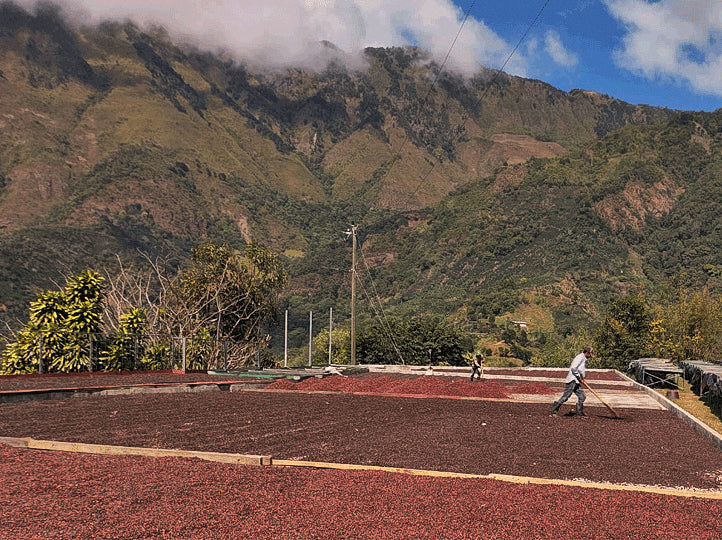
Finca Casa de Piedra is one of two farms operated by Cafe Directo, a family business founded in 2013 by Father and daughter team, Gerardo and Jennifer Arias. The farm is dedicated to the production, processing, and marketing of the finest Costa Rican Tarrazú coffees in harmony with the environment. Directo’s vision is to contribute with the development of our society through fair and ethical trade.
Its founders have over thirty years of experience in the production and processing of specialty microlots qualities including naturals, yellow, red, and black honey, anaerobic, semi-washed and fully washed processes.
The unique conditions on the farm - in particular its microclimate and soil type, as well as elevations up to 1,800 masl - allow for a wide range of varieties to flourish, including Catuai, pacamara and geisha.
THE HISTORY OF COSTA RICAN COFFEE Coffee came to Costa Rica as early as 1779 and within 50 years was generating more revenue than any other crop, but by the 1830’s they were growing more coffee than the ships heading south could take. And virtually no infrastructure existed for transporting even a small amount of green coffee to the east coast of Costa Rica (where London was a mere 5,000 miles away). The distribution woes of Costa Rican coffee producers reached the ears of an up-and-coming shipping magnate named William Le Lacheur in 1841 and on Christmas day, 1841 he sailed The Monarch into port at Puntarenas, Costa Rica, and thus began a long and mutually beneficial relationship. On one voyage to London in late in 1843, the Monarch carried more than half a million pounds of Costa Rican coffee.
THE PROCESS The full details of the Finca Casa de Piedra anaerobic process are a closely guarded family secret. However here is what we do know:
Cherry selection is paramount. Brix readings are taken to ensure the cherries are harvested at the optimum time.
The cherries are then pre-dried on cemented patios for 48 hours, prior to fermentation
Extended cherry fermentation is carried out in plastic tanks without valves.
Temperature is controlled throughout the fermentation process and Brix is monitored, as well as the aroma and appearance of the pulp.
After fermentation the cherries are dried on raised beds for an average of 30 days